




Cultural Differences And Miscommunication In Business

Cultural Differences And Miscommunication In Business

Cultural Differences And Miscommunication In Business

Order Instructions:

Nothing else apart from the heading

SAMPLE ANSWER

Cultural Differences And Miscommunication In Business

Difference in cultures/ cultural diversity

Cultural diversity implies to values, traditions and, norms that affect the manner members of a group or different nationalities typically think, perceive, interact, make judgments and behave. In business, it impacts on daily scheduling and deadlines because different cultures have different perceptions of time. They say globalization has shrunk the Globe in to a small village. It’s very encouraging seeing people from different parts of the word interaction and transacting business with ease. However, it has not simple, when it comes to the corporate world. Increasingly, managers in different nations must deal multi-ethnic groups with very dissimilar cultural diversities in their organizations. These days, you are likely to work with Canadians, Australians, French, Japanese, German or even Chinese and all other sorts of nationalities in your workplace (Diversityresources, 2015).

The first step of countering this scenario is recognizing that people from different cultural backgrounds are different in all aspects. They have a special way of viewing things, a different code of dressing and a different personality.

In a business setting, these differences can cause problems and a lot of misunderstanding. It would be difficult to deduce what the other person is doing or saying. This problem is known as miscommunication. Other problems include conflicting behaviors and perceptions (Norlyk & School, 2010).

Miscommunication                                                                                                                           

Communication context

The root/ cause of miscommunication between different nationalities is the context of communication. Cultural diversity has divided communication context in to two; high and low communication contexts. Some cultures are into a high communication context while others are used to low context. In high context communication, information is either internalized in the person or it’s physical. Behaviors are implicit, meaning that the context gives you cues on how to behave. These people tend to use a more circuitous approach of communication. Japan, china, Korea and, Latin American countries prefer the style of communication (Martin, 2009).

Verbal content communication is most evident in low context cultures. Information is wholly conveyed through word of mouth from one agent to another. The expectations and rule of communication are explained and discussed. In other words, these nationalities prefer more direct communication technique. Direct communication is most common in Canada, United States and some other European countries (Martin, 2009).

How miscommunication can be prevented

Cultural competence training

Cultural competence is the virtue/ ability of a person to interact and communicate effectively with people from different Nations and cultures. This ability is built on ones awareness on cultural worldview, cross-cultural skills and cultural tolerance. To avoid problems, cultural competence guidance is necessary international business transactions .Miscommunication and actual conflict jeopardizes effective work production and worker performance (Smith& Mounter ,2010).

Communication

Providing information promptly and accurately is vital to effective work and business interaction. However, people from different nationalities vary in how they deliver bad news. For instance, people from Asia are reluctant to give supervision (bad news) while other from African and America may exaggerate it.

Team-building

Some cultures or rather nationalities especially people from United States and Canada are individualistic; they love to do stuff alone. On the other hands some cultures prefer cooperation with others. Team-building in a multiple ethnic setting can be very challenging. Effective multi-cultural team-building is mandatory. It does not only bring the team together but also benefits them from the prospective recompense of cultural diversity (Baumer, 2015).

References

Baumer, T. (2015). Cicb Center for Intellectual Competence-Typical Examples of Cultural Differences. (online) cicb.net. Available at : http://cibs.net/en/home/example (accessed on 20 jan. 2015).

Celt.iastate.edu, (2015). Cultural Differences- Center for Excellence in Learning and Teaching. (online)  Available at : http://www.celt.iastate.edu-resources/international-resouces/cultural Differences (accessed on 20 jan. 2015).

Doing business and investing in Australia. (2010). New York: Pricewaterhousecoopers.

Diversityresources.com, (2015). Managing Cultural Diversity in the Workplace. (online) Available at : http:// diversityresources.com/cultural-diversity-workplace.htm (accessed on 20 jan.2015).

Fhsu.edu, (2015). What is Cultural Diversity- Fort Hays State University. (online) Available at :

http://fhsu.edu/diversity-affairs/what-is-diversity/ (accessed on 20 jan. 2015).

Martin, D.(2009)  Language Disabilities in Culture and  Linguistic  Diversity. Britol, U.K: Multilingual Matters.

Norlyk,b., & School, C. (2010)  Miscommunications and Discause Practices in Occupational

Cultures.Kolding  Handelsholjskole Syd, CESFO.

Smith, L., & Mounter, P. (2010). Effective International Communication (2nd ed.). London: kogan page.

We can write this or a similar paper for you! Simply fill the order form!

Self Reflective Journal Assignment Available

Self Reflective Journal

Self Reflective Journal

Order Instructions:

Write a one page reflection on how the readings (assigned chapters), handouts, and/or articles impact your teaching philosophy, approach, perspective.

SAMPLE ANSWER

Self Reflective Journal One

As teachers, we are supposed to be open-minded when it comes to teaching. This is in the sense that all students are starting at the same point and should be taken as such regardless of their level of understanding. In most cases, I have come to see that as teachers, we get classes that are well balanced ethnically but are blinded to see how the students relate to each other from all aspects such as culture, religion, or background. For instance, if a child is new to the class and his or her culture is different from most of the other classmates, there is a high chance that if the teachers are not keen there will be a form of discrimination and the child might feel left out and not live up to their full potential (Patrick, Hisley and Kempler, 2000).

Over the years, as I have interacted with parents, each believes that their child has the capacity to achieve all they desire with proper guidance. This has acted as a calling to me to know that parents consider a teacher as a building foundation that will help their children achieve success. In essence, it has opened my eyes to the fact that as the teacher, I am supposed to ensure that children are not limited to attaining their goals based on how I and the rest of classmates relate.

According to Sullo (2009), the teacher is the key motivator of all students. This is a revelation to ensure I become the link between students and their success. In addition to this, I have learnt that education is a continuous process that we all learn from both teachers and students. From a general point of view, as a teacher I have come to appreciate the different students that we receive and teach in our classes. Through them and through interaction with their parents, one gets to learn of their different cultures, values, and belief, and a way to deal with them without favoring one or the other.

References

Patrick, B., Hisley, J. and Kempler, T. (2000). “What’s Everybody So Excited About?”: The Effects of Teacher Enthusiasm on Student Intrinsic Motivation and Vitality. The Journal of Experimental Education, 68(3), pp.217-236.

Sullo, R. (2009). The motivated student. Alexandria, Va.: Association for Supervision and Curriculum Development.

We can write this or a similar paper for you! Simply fill the order form!

Global leadership development programs

Global leadership development programs

Global leadership development programs

Order Instructions:

It is certainly a cliché that we are living in a ‘global world’ and as such the concept of ‘global leadership’ may be seen to be a somewhat nebulous one but the reality is that there is increasingly greater communication on a global scale and leaders need to cope with this. Morrison (2012) seems to suggest that MNEs – presumably Western ones – do not recognise the extent to which leadership skills on a global basis need to be developed and as such may have a poor understanding of how to develop them. Please see the attached article and think of suggestions for improvement.

please read the attached file:

Morrison, C., (2012), Global leadership development: a case of misplaced optimism? People & Strategy. Vol. 35 Issue 2, p18-20.

SAMPLE ANSWER

Global leadership development programs

Developing global leadership mindset is an iterative procedure. The process integrates the know how, cultural competence, communication and managerial expectation.  To select a good global leader, the organization should identify the talents, experiment their abilities by offering them opportunities to work with cross cultures in order to nurture their talents.  This will enhance their creativity; make them more vibrant and empowered.  However, most companies leadership development programs are not in place. The programs are facing numerous challenges. For instance, most organization selects the high potential managers to participate in the development program i.e. lack participants selection criteria.  In most cases, these managers global mindset are more individualistic than collective.  The individualistic cognitive approach influences the global leadership development program performance negatively. It also denies other young and talented leaders from participating in such programs (Morrison, 2012).

In this context, Conventional definition of global leadership that implied that posting staff overseas or establishing new operations there. Most of the organizations base their leadership development programs using their long term strategies; keeping their focus more internal. With the increase globalization and internationalization of financial markets and the multicultural society, there should be a clear distinction between national leadership and international leadership; the two leaderships should be re-interpreted/re-defined to include the concepts that domestic contexts are taken overseas whereas the international dimension comes to local territory i.e. link their interdependency. Secondly, a standardized global leadership program evaluation metrics should be established to evaluate the program’s effectiveness. These  metrics will assist in; establishing criteria for choosing participants; evaluation of the current and future organizations leadership competencies; measure the outcomes produced by the leadership development program and lastly to identify gaps and facilitate in shaping the content to eradicate the gaps (VanderPal &Shan, 2014).

 References

Morris.C. (2012) Global leadership development: A case of misplaced Optimism? People &Strategy 35; 2, 18-20

VanderPal, G., & Shan, VC. (2014) An overview of global leadership: ethics, values, cultural diversity and conflicts. Journal of leadership, accountability &ethics 11; 3,166-177

We can write this or a similar paper for you! Simply fill the order form!
Damped trend method Assignment

Damped trend method
Damped trend method

Damped trend method

Order Instructions:

The writer need to follow the link below read the article and then in a one page document comment on it in APA format and properly cite the article in APA format.

Students, for more information on the damped trend method, comment on the link below.

7.4 Damped trend methods | OTexts
https://www.otexts.org/fpp/7/4

https://www.otexts.org/fpp/7/4

SAMPLE ANSWER

Damped trend method

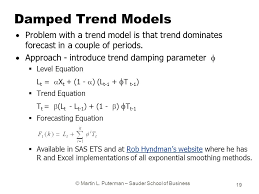
According to the article, there are a number of methods used in making forecasts decisions (Hyndman, 2014). The article delves on damped trend methods and compares it with other methods used to generate forecasts such as Holts’ linear method. One noticeable feature or difference between the damped trend methods and the Holt’s linear method is that Holt’s method as it displays constant changes that is either increasing or decreasing indefinitely into the future (Hyndman, 2014).  On the other hand, the dampened trend methods usually dampen the fault line in the future which in one of the differences between the methods compared to others. This dampening has proven successful hence many people like the method especially when they want automatic forecasts for many series (Kauczor, Norman, Christiansen & Coriani, 2013).

Other forecasts methods the article highlights include Exponential, SES, additive and multiplicative. These methods have same characteristics as Holt’s linear method because they   lead to extreme results either increase or decreases in their future (Phojanamongkolkij, Kato, Wielicki, Taylor & Mlynczak, 2014).

These methods have their advantages and disadvantages hence, used in various situations as deemed appropriate.  For instance, Holt’s linear trend method provides best fit to the data presented then followed by additive linear trend method. On the other hand, simple exponential smoothing takes the lead in generating largest within sample one-step errors (Hyndman, 2014).

The article provides in-depth analysis of these methods. They are compared to provide insights on the most accurate method in forecasts which enhances understanding of their suitability.  Therefore, through the articles, in-depth knowledge and understanding of these methods is provided.

The article is clear and precise. Citation and organization is up to standard hence enhancing understanding.  The information and arguments raised are well supported with credible references making it more credible and persuasive. The article as well has graphs and tables that illustrate the theoretical information hence menacing understanding.

References

Hyndman, R. (2014). Forecasting: Principles and practice. Retrieved from:             https://www.otexts.org/fpp/7/4

Kauczor, J., Norman, P., Christiansen, O., & Coriani, S. (2013). Communication: A reduced- space algorithm for the solution of the complex linear response equations used    in coupled cluster damped response theory. Journal of Chemical Physics, 139(21):211102-211102-4. DOI: 10.1063/1.4840275.

Phojanamongkolkij, N., Kato, S., Wielicki, B.,Taylor, P., & Mlynczak, M. (2014). A Comparison of Climate Signal Trend Detection Uncertainty Analysis Methods.  Journal of Climate, 27( 9):3363-3376. DOI: 10.1175/JCLI-D-13-00400.1.

We can write this or a similar paper for you! Simply fill the order form!

Clinical Teaching for Learning Assignment

Clinical Teaching for Learning

Clinical Teaching for Learning

Order Instructions:

PLEASE see attached file

SAMPLE ANSWER

Clinical Teaching for Learning

Transformation of information has taken its major in the field of nursing. Researchers have made numerous discoveries and improvement in the recent past. The process of acquiring information, preparing it for adoption is what specialists call evidence based practice (EBP). However, the information should be a suggested improvement in health processes acquired in research (Titler, 2008). EBP is a gradual process that involves information acquisition and evaluation before implementation. Academics argue that less has been done when matters of EBP implementation are concerned (Drisko & Grady, 2012). Most of the improvements discovered have been discarded or put on hold due to various factors. EBP has been considered to be more of a social strategy since it involves opinion pooling and decision making at diverse levels. It is also a practice that keeps practitioners up to date and effective in their practice (Titler, 2008).

EBP, as any program of change has a number of determining factors. These factors can either be negative or positive. It is usually up to the people in charge to analyze and come up with a better patient outcome (Burns &Grove, 2001).

As a practitioner, I will ensure that the practice is patient centred. With the innovation in mind, patient safety should be prioritized. The medical improvement should not cause negative implication to the patients since they are the sole purpose for the improvement (Beyea & Slattery, 2006). There should be a thorough evaluation of the project during planning and before implementation.

Beyea and slattery in their book (2006), argue that the team to work on the EBP should be well informed in the field. They further suggest that the task should be left for the experts. For example, suggested improvements to be made in the cardiovascular role should be left in the hands of the cardiac practitioners. I would therefore consider the team I am working with and ensure there are no errors during planning and implementation of the project.

The administration is also a key factor to consider when planning and implementing EBP. The stakeholders should approve of the improvement for it to be implemented. The nurse might have an idea but the administration has a different view on it. The improvement might appear dehumanizing or simply inappropriate for patient used hence the administration will decline the process (Klein and Sorra, 1996). Since EBP involve decision making, I will consider involving the administration and the learners in each stage of the process.

Consideration of the cost of implementing EBP is among factors that influence the process (Drisko & Grady, 2012). This will be achieved through task orientation. A thorough plan on how the learners will achieve a clinical learning environment is essential. This process should also be less costly. The research outcome should be able to evaluate the cost of the due process. I will align the cost of implementing the process with the potential benefit in order to ensure no miscellaneous expenditures are recorded.

I would consider government policies concerning the project. It should be totally legal and approved by the healthcare regulations. For an EBP to function there should be no barrier from the government. The process must not go against the legislative laws.

The research should be easy to interpret, and must have had enough time assigned to it. The researchers must plan and dedicate ample time to the research for quality evidence-based report (Beyea & Slattery, 2006). As the project leader, I would make sure the research is thoroughly done to perfection so as not to jeopardize patients’ situation. Time will be dedicated to vetting of the team and reading through the research.

Resistance from the patients will be looked into and resolved. Patient barrier is among the factors that pose a challenge to change in healthcare services (Montgomery & Bailey, 2007). The patients will be assured of their safety and well being all through the process of implementation of the medical improvement. A positive feedback from patients is a sign of quality healthcare improvement.

Other factors worth considering include cultural, demographic and social factors. The change should be compatible with the stated factors. For instance, the organizations and stake holders should have a common interest. Demographic variability usually has an impact on the research findings. It will also be noted that the improvement relates to the current medical culture (Montgomery & Bailey, 2007).

It is worth noting that for change to be adopted, there are some issues that must be looked upon. EBP is a practice that occurs frequently in the clinical level. Patients should be accorded the best treatment in every healthcare facility. Practitioners have to reduce the effect of infections by introducing improved antibiotics and medical equipments.

Teaching Plan

Topic: Evidence based practice

Target Group:

Learning Outcomes Content Points Teaching Strategy/ies and resources Assessment Strategies
*Professional skills

*Evidence based practice.

*Intellectual skills

*Good leadership

*Creating a positive learning environment.

*Patient consideration throughout the practice

*Acquisition of nursing skills that will allow both the leaner and teacher to benefit.

*Utilizing the learning process to achieve more technique on the practice.

*Gain knowledge based skills to assure quality services.

*Leadership skills to be nurtured by taking initiative in the learners programs.

*Being mindful of the effects of the procedures on the patient’s health.

*Innovative approach

*Involvement in the practice stages.

*Provision of recommended learning materials.


*Enhance the leadership skills through planning through the whole process.

*Positive attitude towards the student’s and the field of teaching.

*Educating on improvised structure’s effects on the patient.

*Enabling the learner to catch up with the changing methodologies.

*Increase the knowledge of EBP through quality teaching.

*Helps the learner to evaluate the patient needs

*quantitative feedback.

Through learner involvement, knowledge of patient needs is achieved

 Task Two

Nursing students have various needs according to Mckimm and Jollie (2003). The various needs influence the students’ performance and also their interest in the discipline. Clinical learning needs are the intellectual, emotional and physical requirements by medicine students in the learning environment. It is therefore essential that all clinical instructors consider the needs of their students and satisfy them. This way the instructor has to view things at the students’ point of view.

Among the clinical needs of a student is the need to belong. The student requires having a sense of belonging. They want to feel the importance and benefits of choosing their healthcare course. Research shows that most students from Australia and UK go through challenges brought about by lack of belongingness (Mckimm & Jollie, 2003). This issue is normally caused by various factors which are mostly teacher related. However there are other factors which will also be discussed in this essay.

As a clinical instructor, it is my duty to ensure academic success is experienced by all my students. I will therefore equip them with outstanding qualities and skills that will enable them endure some challenges. I will have a positive attitude towards my students during and off lecture hours. It has been argued that negativity from the lecturers has led to some students totally losing interest in the field of study (Mckimm & Jollie, 2003). In order to avoid such an occurrence, my staff-student relationship will be free and positive.

Correlation between students is among the numerous strategies I will introduce. The students will have to create a strong academic bond that will enable them to study together. Brainstorming groups will be formed in the classes and will be coordinated by the students who in turn will be bringing progress report within a given span time. I will also suggest a student team that will be in charge of counselling the weak demoralized students. This will bring a feeling of family and belongingness. It has been recorded that team work has relatively influenced university performances (Duff, 2010).

Participation of the students in my service as a practitioner will also be an essential part of my plan. I will engage my students in an observation program. They will be observing as I prescribe to various patients. This will increase their will to continue with the course and feel attached to it. Duff in (2010) also suggests that familiarizing with the environment reduces anxiety and provides a more comfortable sensation to a human being. I am planning to create a positive clinical learning environment to the students.

Among the causes for students’ feeling misplaced is poor educative content coming from the course instructor (Kern, et al 2014). A wide background reading will be a part of my teaching plan. This move will help when trying to equip the students with dimensional view of certain study areas.

I will ensure practical work is put to practice and thoroughly followed. Encountering various infections will expose my students to more of real work than just theory dependant issues. Academics argue that exposure to the main clinical practice procedures increases the students academic productivity. This allows them to become better and more efficient in their professional lives (Kern, et al 2014). More time in the operation rooms will expand their knowledge of the field of nursing.

Competition is among the strategies that I plan to keep up with. The students will have academic platforms to compete with students from other tertiary institutions. Competition is the basic to students’ critical evaluation of healthcare challenges. It matures the brain and positively impacts the IQ (Johns & Lathlean, 2007). It is further argued that a competent environment together with a good foundation generates a feeling of natural belonging.

Research will be done by a team of academic analysts to analyze on the performance of the students and other possible strategies that will reduce the needs of students.

Conclusion

Students need is not supposed to be viewed as a drawback but rather as a challenge. It is a challenge that brings positive outcome; it should therefore be tackled by both the instructors and students from all tertiary institutions. Most of the students needs correlate. This means that facing one reduces the challenge posed by the rest.

References

Beyea, C.S., and Slattery, J.M. (2006). Evidence-Based Practice in Nursing. UK: HCPro Inc.

Burns, N., and Grove, s. (2001). The Practice of Nursing Research: Conduct, Critique and Utilization. 4th ed Philadelphia: W.B. Saunders Company.

Drisko, J., and Grady, M. (2012). Evidence-Based Practice in Clinical Social Work. New York: Springer-Verlag.

Duff,   B. (2010). Development and Evaluation of an Integrated Clinical Learning Model to Inform Continuing Education for Acute Care Nurses. 6(9) doi: 1685-1083

Kern, A., Montgomery, P., Mossey, S., and Bailey. P. (2014). Undergraduate Nursing Students’ Belongingness in Clinical Learning Environments: Constructivist grounded theory. 4(3) doi:10.530/jnep.v4n3p133.

Jones, L.T., and Lathlean, J. (2007). Belongingness: A prerequisite for Nursing Students’ Clinical Nursing. 24(3) doi: 469234-0002394

Klein K.J., and Sorra, J.S. (1996). The Change of Innovation Implementation. The Academy Management Review 21(4) doi: 1055-1080.

McKimm, J., and Jollie, C. (2003). Facilitating Learning: Teaching and Learning Methods. London: London Deanery.

Montgomery, P., Bailey, P. (April, 2007). Field Notes and Theoretical Memos in Grounded Theory. Western Journal of Nursing Research. 29(1): 65-79.PMid17228061 http://dx.doi.org/101177/019345906292557.

Titler, G.M., (2008). Patient Safety and Quality. US: Rockville (MD).

We can write this or a similar paper for you! Simply fill the order form!

Collaboration in Salud Term Paper

Collaboration in Salud Term Paper Order Instructions: Discussion – Week 8
Collaboration in “Salud” and in Your Group Work

Public health is basCollaboration in Salud Term Paper

Collaboration in Salud Term Paperbased largely on collaboration and partnership—within an organization and with various community groups, individuals, and other entities. For leaders, finding ways to motivate and problem-solve with others in pursuit of a common goal can both inspiring and challenging.


Review the different kinds of collaborations and partnerships among organizations and stakeholders that were described in the video documentary Salud, and consider which were the most effective in achieving the public health goals. Then reflect on the group work you have engaged in so far in this course, and assess your experiences in light of what you have been learning about collaboration, partnership, and leadership within an organization. What lessons can you point to in the video, as well as in your own group work, about what makes for successful collaboration?

ANSWER THE FOLLOWING QUESTIONS:

1. Identify at least two specific strategies for collaboration or partnership with stakeholders and organizations shown in the video Salud and explain why they succeeded or failed, based on the principles you have learned about this week.

2. How has it been to work in a group so far in this class? Describe one or two specific strategies you have used so far in your group work to motivate others for collaborative problem-solving and decision-making. How well have these worked? Identify also one notable instance of a strategy any of your group members have used.

3. Compare/contrast these with strategies you saw in Salud. Are there any lessons from this documentary you can apply in your group work?

USE THESE WEBSITE AND Online Video:

1. Field, C. (Director/Producer), & Reed, C. (Producer). (2006). ¡Salud!: Part 2 Decatur, GA: Medical Education Cooperation with Cuba.
©MEDICC, 2006 – All Rights Reserved – saludthefilm.net

2. Field, C. (Director/Producer), & Reed, C. (Producer). (2006). ¡Salud!: Part 3 Decatur, GA: Medical Education
Cooperation with Cuba.
©MEDICC, 2006 – All Rights Reserved – saludthefilm.net

Please apply the Application Assignment Rubric when writing the Paper.

I. Paper should demonstrate an excellent understanding of all of the concepts and key points presented in the texts.

II. Paper provides significant detail including multiple relevant examples, evidence from the readings and other sources, and discerning ideas.

III. Paper should be well organized, uses scholarly tone, follows APA style, uses original writing and proper paraphrasing, contains very few or no writing and/or spelling errors, and is fully consistent with doctoral level writing style.

IV. Paper should be mostly consistent with doctoral level writing style.

Collaboration in Salud Term Paper Sample Answer

Collaboration

Collaboration among all people is essential for efficient delivery in the public health sectors. Collaboration has various strategies which are distinct in their outcomes. In the video Salud, two specific collaboration strategies are identified, including coalition, voluntary services and community partnerships. The health ministry and other government sectors collaborated to establish solutions that went beyond curative services. From the strategies observed in the study, there is shared domain of responsibility. The medical practitioners in Cuba shared knowledge instead of competing each other. Their success is attributed to the fact that there was no use of advocacy, exclusion or hierarchal. Their strategies de-emphasized power and status among the participants and encouraged collective ownership (Field &Reed, 2006).

Working in groups is an essential strategy for interactive learning. The collaboration strategies and principles were of massive support to the team.  The group applied network collaborative strategies; the model entailed of consultative feedback between the team. Every individual had equal opportunity to present their ideas. The group had clear structure and expectations of the project. These included highlighting two things whose progress seemed alright, ideas that required improvement. This training facilitated the idea that health workers should not work in isolation from other disciplines during legislative process or soliciting funds from government or private institutions. Additionally, themes such as mutual respect, cultural competence, capacity building and sustainable leadership prevailed (Upvall &Leffers, 2014).

Evidently, collaboration provides a powerful intervention to respond to complex issues that are irresolvable by isolated efforts. Lessons learnt from the video are that collaboration efforts succeeds only if there is shared goals, all inclusive with zero hierarchical participation. There should be room for negotiation and people are kept up to date as situations arise (Upvall &Leffers, 2014).

Collaboration in Salud Term Paper References

Field C&Reed, C. (2006) Salud! Part 2 Decatur, GA: Medical Educational cooperation with Cuba. Retrived on January 18th, 2015 from [saludthefilm.net]

Field C&Reed, C. (2006) Salud! Part 3 Decatur, GA: Medical Educational cooperation with Cuba. Retrived on January 18th, 2015 from [saludthefilm.net]

Upvall, M., &Leffers, J. (2014) Global health nursing: building and sustaining partnerships. Springer publishing company, New York.

We can write this or a similar paper for you! Simply fill the order form!

The Origin of Old-Earth Geology Term Paper

The Origin of Old-Earth Geology

The Origin of Old-Earth Geology and its Ramifications for Life in the 21st Century

Order Instructions:

READ

http://www.answersingenesis.org/articles/tj/v18/n1/old-earth-geology

Content

In general, each Journal Article Review must contain an introductory paragraph, the body of the work, and a conclusion. In terms of the body, the following items must be discussed:

1. Brief overview of the theme of the article and its main points.
2. Strengths of the article. Answer questions such as:
a. What did the author do well?
b. Were any points made exceptionally clear?
c. Did the author write with concision and precision?
3. Weaknesses of the article. Answer questions such as:
a. What erroneous assumptions does the author make, if any?
b. Are any factual errors made in the article?
c. Is the scientific method violated in any way?
d. Could the author have stated his/her case better?
4. Remember, every article has weaknesses. You are expected to discuss some of these. Failure to identify any weaknesses in your Journal Article Reviews will negatively affect your grade.

Outline

Use the following outline when writing your papers. Each point on the below outline must be a separate section (with a section heading) within each of your Journal Article Reviews. You will notice that these section headings correspond to the content points above.

I. Introduction
II. Brief Overview and Main Points
III. Article Strengths
IV. Article Weaknesses
V. Conclusion

Length
These reviews are to be 2–3 pages each. Do not exceed this page limit. The title page and bibliography do not count toward this page total.

Format

You must use current APA formatting. Papers must be double-spaced with 1-inch margins all around. The font is to be Courier New or Times New Roman, 12-point.

Include a cover sheet with your name, instructor’s name, course number and title, date, and paper title. There is no need to include an abstract in your paper.
Sources

The only source required for each review is the article itself. However, feel free to incorporate other sources if you so desire. Additional sources must be limited to journal articles, manuscripts, scholarly textbooks, and/or internet sites from .edu or .gov sources. Avoid internet sites from .com, .net, .org, etc. sources as the information contained therein are not often peer-reviewed. Also, Study Bibles are not appropriate for this assignment. List all of your sources in a bibliography at the end of the paper.

Citation

Be sure to cite your sources in the body of your paper using proper APA formatting.

SAMPLE ANSWER

The Origin of Old-Earth Geology

The Origin of Old-Earth Geology and its Ramifications for Life in the 21st Century

Introduction

This paper is a review of Dr. Mortenson’s article, Origin of Old-Earth Geology and its Ramifications for Life in the 21st Century. The paper will also give the article’s strengths and weaknesses. It is essential to note that Dr. Mortenson’s article does not take sides, but rather gives information found in his thesis development, for this reason this paper will review of Dr. Mortenson’s hypothesis and information.

Overview of the articles main points

Doctor Terry Mortenson’s article is about the history of the Old Earth Geology and the consequences of its ideologies on the present day society. In essence, the article gave limited background or knowledge of the Old-Earth theory, but it explains the main Scriptural Geology by arguing on the legitimacy of the belief on Young-Earth, and closing with a generalized visualization of the impacts of the Old-Earth theory on the society.

Article Strengths

The article make successful attempt of identifying the author’s discontent with the modern science flaws, as well as, the modern societal downfall. Doctor Mortenson gave vast details on the validity of his belief and credential of Scriptural Geologist theories. The author in seven paragraphs successfully gave a discussion on the dynamic background and the development of Scriptural Geology using important individuals in Scriptural Geology community. The article successfully depicted flaws in the modern scientific, historical scientific and scriptural scientific thinking (Mortenson, 2003). Additionally, the article depicts flaws in science and research that attempts to disprove or prove Old-Earth creation. According to the author, each hypothesis developed is based on its worldview, and would spend energy attempting to prove that it is trues as opposed to proving that it is open to other alternatives. Dr. Mortenson’s article greatest strength is that it is informative and detailed.

Article Weaknesses

It is evident from the article that the author is biased in the way he significantly deviates from the article’s main intent. Dr. Mortenson started his article on the right track by giving a discussion on the background of the Old-Earth, but he ends up deviating and spending about 12 paragraphs discussing on science outside the Old-Earth Geology, as well, as the argument of such sciences against the Old-Earth’s theory; these sections were irrelevant, but only took away the article’s discussion from its original intent.

Dr. Mortenson’s claim against naturalist is the weakest point of the article. It is known that naturalists have greatly contributed to morality and justice in the society. People with naturalist beliefs in the present day society provide and love their families, go to work, help others, partake charities and strive to be good people; therefore, , Dr. Mortenson’s position on naturalist does not sound valid.

Conclusion

Dr. Mortenson’s article had a good premise; the author’s information proved to be interesting and informative; however, the author fell off the topic for a good part of the article, as well, as making ridiculous claims at the final section of the article. His idea that the Old-Earth ideology and naturalism are responsible for the societal downfall is over-generalized and erroneous. Personally, I think the article is informative, but it loses its credibility and legitimacy based on the authors’ failure to covey his information in a non-exaggerated and concise manner. As a person looking forward to understanding the development and history of Old-Earth theory, as well as, its impact on the society, this article is not impressive.

References

Mortenson T., (2003.). The Origin of Old-Earth Geology and its Ramifications for Life in the 21st Century, 1/9-6/9

We can write this or a similar paper for you! Simply fill the order form!

Evaluating Surveillance Systems Essay Paper

Evaluating Surveillance Systems

Evaluating Surveillance Systems

Order Instructions:

Evaluating Surveillance Systems

The growing interest and significant investment in electronic surveillance systems have fueled the demand for techniques that accurately evaluate their effectiveness. analyze issues associated with evaluating electronic disease surveillance systems.

post an analysis of the issues associated with evaluating the effectiveness of electronic disease surveillance systems. Include an explanation of how you would address the interests of multiple constituencies.

SAMPLE ANSWER

Evaluating Surveillance Systems

Introduction

Throughout the world, the recent past years have seen an increased implementation of electronic surveillance systems. Such systems include syndromic reportable systems and electronic disease surveillance systems; these systems have helped in increasing the amount of data available to public healthcare givers and agencies in almost real time. However, the effective use of such systems require efficient access of data from various sources, for this reason, there are a number of issues surrounding the effective use of electronic disease surveillance systems. This paper seeks to analyze the effective access of surveillance data as an issue associated with the evaluation of electronic disease surveillance systems. The paper will draw examples from, the NC EDSS (North Carolina Electronic Disease Surveillance System), a syndromic electronic surveillance system.

Analysis of an issue surrounding electronic surveillance systems

Between April and October 2009, data collected by NC EDSS was analyzed by a group of researchers from NCPERRC (North Carolina Preparedness and Emergency Response Research Center) (Samoff et al., 2012). Additionally, a number of public health staff members that might have interacted with the system or had used data from the system were surveyed to give their experience concerning the system. The use of NC EDSS was assessed in accordance with the event investigation of the H1N1pandemic, and based on policy development, program management and reporting. It was found from the study that the use data from the surveillance system in North Carolina’s local, regional and state level lead to meaningful public health actions including disease detection and disease management, as well as, disease informing program management. Healthcare givers used data derived from the syndromic surveillance system for the common detection public health events and for the traditional public health needs.

Thought it was evident from the 2009 study that the data from the NC EDSS resulted in a meaningful public health action, the study also found out that many potential users of the data from the system did not have access to the system (Samoff et al., 2012). When public health staff receives information from expert users of electronic surveillance systems, they find such information to be useful (Bravata et al., 2004); this suggests that the access to surveillance data should be efficient enough to allow public health staff to integrate the system’s data with other surveillance information for policy development, program management and event investigation.

Since efficient access is an issue surrounding electronic surveillance system, two approaches can potentially be applied to address the issue. To support public health responsive review of surveillance data, it is essential to employ a centralized approach and the forwarding of relevant information to various potential users. A decentralized approach can also be used as it will help in the development of simple and efficient access to electronic surveillance systems (Chretien et al., 2008); this will guarantee NC EDSS and other surveillance data to be available over a single platform.

Conclusion and recommendation

To prioritize efficient access of surveillance data, it would be essential to make changes to surveillance systems’ training and programming so as to better support NC EDSS and other surveillance data access and use. It would also make sense if protocols were developed to make it clear when NC EDSS and other surveillance systems can be access in public health practice. It would also help if custom-based capacity search was developed to allow customized and flexible use of surveillance data at different levels, as well as, to facilitate potential cluster investigations that may not be captured by the surveillance systems.

References

Bravata, D. M., McDonald, K. M., Smith, W. M., Rydzak, C., Szeto, H., Buckeridge, D. L., … & Owens, D. K. (2004). Systematic review: surveillance systems for early detection of bioterrorism-related diseases. Annals of Internal Medicine, 140(11), 910-922.

Chretien, J. P., Burkom, H. S., Sedyaningsih, E. R., Larasati, R. P., Lescano, A. G., Mundaca, C. C., … & Lewis, S. H. (2008). Syndromic surveillance: adapting innovations to developing settings. PLoS medicine, 5(3), e72.

Samoff, E., Waller, A., Fleischauer, A., Ising, A., Davis, M. K., Park, M., … & MacDonald, P. D. (2012). Integration of Syndromic Surveillance Data into Public Health Practice at State and Local Levels in North Carolina. Public Health Reports, 127(3), 310.

We can write this or a similar paper for you! Simply fill the order form!

Biblical Worldview Essay Term Paper

Biblical Worldview Essay

Biblical Worldview Essay

Order Instructions:

BIBLICAL WORLDVIEW ESSAY INSTRUCTIONS

Rationale for the Biblical Worldview Essay

Every person has a worldview whether he realizes it or not. What is a worldview? James W. Sire defines a worldview as:

[A] commitment, a fundamental orientation of the heart, that can be expressed as a story or in a set of presuppositions (assumptions which may be true, partially true or entirely false) that we hold (consciously or subconsciously, consistently or inconsistently) about the basic constitution of reality, and that provides the foundation on which we live and move and have our being.

Stated more succinctly, “…[A] worldview is simply the total set of beliefs that a person has about the biggest questions in life.” F. Leroy Forlines describes such questions as the “inescapable questions of life.” Life’s inescapable questions include the following: “Is there a God? If so, what is He like? How can I know Him? Who am I? Where am I? How can I tell right from wrong? Is there life after death? What should I and what can I do about guilt? How can I deal with my inner pain?” Life’s biggest, inescapable questions relate to whether there is a God, human origins, identity, purpose, and the hereafter, just to mention a few.

Satisfying answers to the “inescapable questions of life” are provided by the Holy Scriptures. The Holy Scriptures, consisting of the Old and New Testaments, form the starting point and foundation for the biblical worldview. More specifically related to our purposes, the apostle Paul reflects several components of the biblical worldview in his letter to the Romans.

The apostle Paul authored Romans toward the end of his third missionary journey, about 57 A.D. He addressed this letter specifically to the Christians in Rome. At the time the church in Rome consisted of Jewish and Gentile believers, with Gentile Christians in the majority. Paul wrote to the Christians in Rome in order to address specific concerns and challenges they were facing. While Romans was an occasional letter (not a systematic theology), Paul presents the Gospel of Jesus Christ in a very systematic fashion. The Gospel is actually the overarching theme of Romans as Paul spells this out in his programmatic statement in 1:16–17. As the systematic presentation of the Gospel of Jesus Christ, Romans is foundational to the biblical/Christian worldview.

Recognizing that Romans is not a systematic theology and does not contain all the essential truths that are relevant to a worldview per se, the apostle Paul articulates truths that are foundational to the biblical worldview. In Romans 1–8, Paul addresses certain components of a worldview that relate to the natural world, human identity, human relationships, and culture.
In a 750–1000-word essay, describe what Romans 1–8 teaches regarding (1)the natural world, (2)human identity,(3) human relationships, and (4) culture. Furthermore, (5)explain how this teaching of these topics affects your worldview. Make sure that you address each of these topics in your essay.

• As an essay, it must be written with excellent grammar, spelling, and style.
• Begin your essay with an interesting introduction that contains a precisely stated thesis. End your essay with a strong conclusion that summarizes your main points succinctly.

Structure of assignment paragraphs:

• Introduction/Thesis (approximately 75 words)
• The Natural World (approximately 150–200 words)
• Human Identity (approximately 150–200 words)
• Human Relationships (approximately 150–200 words)
• Culture (approximately 150–200 words)
• Conclusion (approximately 75 words)
• Use each of the categories above as headers for each paragraph in your essay.
• The body of your essay must address the specified components of the assignment in excellent grammatical style.
• Your essay must be typed in a Microsoft Word document using Times New Roman, 12-point font.
• It must be single spaced, and must contain 750–1000 words.
• All sources must be cited, and a bibliography must be included.
• Format your paper in a Microsoft Word document using current APA, MLA, or Turabian style (whichever corresponds to your degree program). Review the Biblical Worldview Essay Grading Rubric to see the specific grading criteria by which you will be evaluated before submitting your essay.
• Do not footnote Scripture references; cite them parenthetically within the essay body following the quotation or allusion to the biblical text.

SAMPLE ANSWER

Biblical Worldview Essay

Introduction/Thesis

Paul framed the book of Romans based on the faults within the Roman society and culture. As stated by Dr. Jimmy Deyoung in the video Romans; the letter that changed the world that, Paul was able to see a crack or a fault line in the Roman society and was able to use it in writing the book of Romans (‘Romans: The Letter That Changed the World’, 2010). The sins committed in the Roman society during Paul’s day are still he same sins committed in the present day society. Following this, the present society can take major lessons from Paul’s writings. My worldview is that, the society is not going to change for the better; therefore, there is need for salvation and divine intervention to escape such morally decaying world.  This paper will analyze the book of Romans chapter 1-8, and in line with the area of interest, the paper will explore on my view on: the natural world, human identity, human relationships, and culture.

The Natural World

I believe that the natural world is a world of perpetual sin. More sins are presently committed than they were in the Days of Noah (Genesis 6:5), and the same was also evident in Paul’s days where the Roman society was full of every imaginable sin. In the roman society there was homosexuality, worshiping of creations rather than God, paganism and moralists that believed that redemption and salvation could be achieved without God.  The same can be seen in the present day society where some people believe that by simply being good, they can finally find themselves in heaven. The world has not changed, and it is arguable that it will not change for the better; more sins are committed high scale owing to technologies like the internet’s ability to propagate sin by keeping people from allover the world to be connected.  Romans worshiped many gods, because as the empire grew with every country conquered, gods of the conquered countries were put into the Roman temple as a way of winning the hearts and minds of the people (Burbank & Cooper, 2010). In Romans chapter 1, Paul saw this issue as a fault in the Roman society and addressed the issue with the Church of Rome.

Human Identity

Paul in Roman 2:15 was able to categorize humanity as either; saved or unsaved (Jews or Gentiles). The Jews had the law to follow while the Gentiles the unsaved did not. Regardless of this difference, Paul stated that whether humanity had laws or not, both are condemned (Romans 2:12). According to Paul, the Jews are condemned more than the Gentiles because they had the law. Paul in Romans 4:15 asserted that the Jews’ knowledge of the law brings wrath. Through the human evil deeds, humanity is doomed. People tend to believe that they can win God’s favor by just being good, and that their good deed can make them obtain righteousness and even get to heaven. People tend to assume a lot about God, yes God is a loving God, but since God cannot tolerate sin (1st John 1:5), He deals with the issue of sin by separating Himself from it; sin and God cannot be together (Edwards, 2003). The present day society has no difference with Paul’s days, and the man’s tendency to sin has not changed.

Human Relationships

The human nature is meant to deal and interact with people; family friends and strangers; therefore, human relationship is an essential part of humanity. Whether a Gentiles or Jew, man is prone to sin. Following this, the present day human relationships have not difference with Paul’s days, and if man is to improve his human relationship, this can only be achieved through faith in Christ since Jesus is the grand architect of human experience (Sheldrake, 2013). The original human experience as intended by God was perverted by man’s actions back in Eden (Genesis 3). Humanity through its actions has no desire to be liberated and to know God, and for this reason God came up with a plan to save mankind through Jesus (Wright, 2009). Even with the God’s effort, man through his actions continually hampers his ability to lead a blessed and productive life as planned by God. Without God man cannot do anything and is destined to destruction unless he develops a repentant heart and come to God through Jesus Christ. Paul handles the issue of human relation according to how God planned the marriage institute (Romans 7:1-4).

Culture

Culture is an essential part of God’s plan. The present US culture leans towards a culture of pluralizing God, and a pluralized culture not the culture that God expects of a Christian or a Jew. During Paul’s time Caesar proclaimed himself as the savior and God of all his subjects in the kingdom (Wright, 2000). Isaiah pointed out that man’s culture is completely at enmity with God (Isaiah 55:8); this supports my stand on human identity, human relationship and culture because I believe that the world is ungodly. Paul encouraged the Church in Rome by telling them that there was hope, and that there was a way for mankind towards righteousness; through faith in Jesus. In line with Paul in Romans 5:12 and Isaiah in Isaiah 55:8 my worldview on culture is that nothing will ever change and man will never live in accordance with God’s intended culture because man will always fall short before God’s eyes.

Conclusion

In accordance with this paper’s thesis on worldview and specifically in human identity, natural world, human relationships and culture, man has not change and it is evident that for man to succeed he needs the word of God. Rome in Paul’s days is not different to the present day society as it is evident in Paul’s worldview that man is corrupt and morally deprived. Paul clearly points out that, for man to escape God’s judgment he needs faith in Christ as the only way out. Among the Rome’s faults was Caesar’s declaration of himself as god, making the people to liberally live in sin. With the present day society believing in liberal movement that promotes corruption, the society is living in a ‘modern-day-Rome’. The present day society has pagans and moralist who believe that they can get to heaven in their means and terms; meaning that they can attain righteousness in their own self imposed terms. As a Christian, it is essential to understand that everyone is a sinner at heart and that Jesus’ grace is the only way out. No man is better than the other because all have sinned; however, it is essential to know what is wrong and what is right.

References

Burbank, J., & Cooper, F. (2010). Empires in World History: power and the politics of difference. Princeton University Press.

Edwards, J. (2003). Sinners in the Hands of an Angry God. Bridge Logos Foundation.

Kingjamesbibleonline.org,. (2015). ROMANS CHAPTER 1. Retrieved 22 January 2015, from http://www.kingjamesbibleonline.org/Romans-Chapter-1-8/

Romans: The Letter That Changed the World. (2010). USA.

Sheldrake, P. (2013). Spirituality: A Brief History. John Wiley & Sons.

Wright, N. T. (2000). Paul’s gospel and Caesar’s empire. Paul and politics, 160-83.

Wright, N. T. (2009). Justification: God’s plan & Paul’s vision. InterVarsity Press.

We can write this or a similar paper for you! Simply fill the order form!
Elements of Situational, Skills, Style and Trait Leadership

Elements of Situational, Skills, Style and Trait Leadership

How Elements of Situational, Skills, Style and Trait Leadership Approaches Can Be Integrated Into a More Inclusive Approach

Order Instructions:

Dear Admin,
Note: To prepare for this essay please read the required articles that is attached

I need an essay in the following subject:

Explain how elements of each approach examined this week could be integrated into a broader, more inclusive theory of leadership. How would your new approach seek to explain what comprises a good leader? Provide examples that would help to support your theory.

The following conditions must meet in the essay:

1) I want a typical and a quality answer which should have about 1400 words.

2) The answer must raise appropriate critical questions.

3) The answer must include examples from experience or the web with references from relevant examples from real companies.

4) Do include all your references, as per the Harvard Referencing System,

5) Please don’t use Wikipedia web site.

6) I need examples from peer reviewed articles or researches.

Appreciate each single moment you spend in writing my paper

Best regards

SAMPLE ANSWER

Elements of Situational, Skills, Style and Trait Leadership

How Elements of Situational, Skills, Style and Trait Leadership Approaches Can Be Integrated Into a More Inclusive Approach

Leaders use different approaches in their duties and responsibilities. However, there is the question of why some leaders fail yet others successfully thrive. The answer lies in the leadership approach that each leader chooses to follow. Among the approaches that have been discussed and are available for leaders to select include the skills style, trait and situational approaches to leadership (Yammarino et al. 2012). Despite the fact that all these traits are good and make good leaders according to the way leaders use, them, creating a more inclusive approach can help. As a point of view in this paper, there is a belief that integrating all the approaches of leadership in an all-inclusive approach will enhance the performance and effectiveness of all leaders and leadership in general.

When leading a group of people, it is obvious that leaders apply their personal attributes to some extent in the bid to make their goals come out successfully. In the case that a leader chooses to make much use of their traits, they are termed as using the trait leadership approach to ensure their success. In the trait leadership approach, a leader can apply some aspects of their traits including demographics, personality, confidence and intellectual ability (Zaccaro 2007). In the process, they exert some kind of pressure on their followers to heed and follow what is needed. In an inclusive leadership approach to enhance leadership effectiveness, it is important to apply some of these aspects provided that they provide positive effects on the people. If the results are negative, then such a trait should be cut out.

On the other hand, the behavior of a leader also qualifies as among the aspects that leaders choose to use. The style leadership approach was developed from the trait leadership approach (Conger 2004). In its argument, it put forth a claim that a leader that uses their natural style trait fall in the style leadership approach (Conger 2004). However, there are two kinds of behavior that leaders in this bracket use either knowingly or unknowingly. The two kinds of style in style leadership approach include task oriented behaviors and relationship oriented behaviors. In most cases, leaders use the two types of behaviors and combine them to make the style leadership. In relation to an inclusion leadership approach, looking down at the style leadership approach will do injustice to leadership. To integrate the approach into leadership practices, a leader should look out for a beneficial style that will reward both parties. In my example, I once worked in an organization where the leader simply used his style to manage people. For example, if he woke up in the morning and felt like rewarding us, he could give all of us a small token of appreciation. However, he could use his mood to make us work. If we saw him in a relaxed and happy mood, we always knew that he was approachable on that particular day. to use, it seemed like he loved using his style.

The skills and abilities of a leader can make or break them (Uhl-Bien, Marion & McKelvey 2007). However, there are two views that come in when discussing this particular leadership approach. One of the groups that discuss the theory has a claim that skills are acquired and developed in an individual (Uhl-Bien, Marion & McKelvey 2007). However, the other group claims that skills and abilities in leadership are inbuilt (Uhl-Bien, Marion & McKelvey 2007). Despite the two opposing views, the skills leadership theory has held together to make it as a notable approach that can become instituted in a more inclusive leadership approach. In an inclusive leadership style, the use of skills, traits and style in decision making will proof vital. The skills that apply in the skills leadership approach include conceptual skills and technical skills (Uhl-Bien, Marion & McKelvey 2007).

Among the key leaders in the world that have made a name for themselves through their skills and abilities is the Amazon founder and current CEO Jeff Bezos. According to the people that have worked closely with Bezos, they have a claim that he is one of the finest leaders in the world at the moment. Bezos mixes his skills and abilities to run his multi-billion company in the modest of manners (Büchler et al. 2006). Apart from his skills, Bezos has employed his style and traits to make sure that everything in his company goes according to plan. For example, he out rightly uses his integrity, passion and fairness to treat his company clients and employees (). In relation to his style, his natural character has built success for him as a renowned leader and worker.

There is also another leadership approach that can apply in the all-inclusive approach to leaders. The situational leadership approach recounts that all skills, abilities, and style do not count if the situation that a leader is in does not allow (Sims Jr, Faraj & Yun 2009). In a harsh environment, the situation leadership approach demands that a leader should apply an autocratic kind of leadership to make things work (Sims Jr, Faraj & Yun 2009). However, in the situation that all things are going well and there are no difficulties, such a leader gets at will to use any style to run their duties and responsibilities (Sims Jr, Faraj & Yun 2009). In another situation where a leader has trust in their employees because they are trained and competent enough to carry on with their duties, the leader can choose a laissez-faire system (Sims Jr, Faraj & Yun 2009). As a result, the situation determines what the employees will use to make decisions and impact their activities.

Back to the example of Jeff Bezos, Amazon founder and CEO, he is a leader that integrates all the leadership approaches to enhance his credibility and accountability. For example, he has a belief that self confidence as a way of succeeding (Büchler et al. 2006). On the other hand, the same individual hails education and skills as a mandatory requirement for a leader to succeed. In an all inclusive leadership approach, leaders will become advised on how to integrate the various approaches to make their careers and ambitions successful. An effective leader encompasses several aspects including being a good communicator, well educated, enthusiastic, respectful, charming and open to change (Büchler et al. 2006). The quality of being open to change will enable an inclusive leadership approach to develop to help leaders grow in their respective roles and duties (Howard 2005).

Before engaging the all the approaches in ensuring that an all-inclusive approach comes up, there is need to answer the question of the extent to which all the approaches will have to apply in achieving a state of equilibrium. The ability of a leader to practice all the available options in succeeding in roles differentiates successful leaders from failures (Howard 2005). As a result, all leaders have an equal chance to decide on what to put in more and how o regulate them in order to achieve accountability and effectiveness.

In conclusion, integrating all the approaches of leadership in an all-inclusive approach will enhance the performance and effectiveness of all leaders and leadership in general. However, the approach should define a clear strategy on what is more important than the other and where and when to apply them. If the situation works, leadership will become efficient to realize the maximum potential of business entities and organizations.

Reference List

Büchler, P., Martin, D., Knaebel, H. P., & Büchler, M. W, (2006), Leadership characteristics and business management in modern academic surgery, Langenbeck’s Archives of Surgery, 391(2), 149-156.

Conger, J. A, (2004), Developing leadership capability: What’s inside the black box?, The  Academy of Management Executive, 18(3), 136-139.

Howard, W. C, (2005), Leadership: Four Styles, Education, 126(2), 384-391.

Sims Jr, H. P., Faraj, S., & Yun, S, (2009), When should a leader be directive or empowering?

How to develop your own situational theory of leadership, Business Horizons, 52(2), 149-158.

Uhl-Bien, M., Marion, R., & McKelvey, B, (2007), Complexity leadership theory: Shifting leadership from the industrial age to the knowledge era, The leadership quarterly, 18(4), 298-318.

Yammarino, F. J., Salas, E., Serban, A., Shirreffs, K., & Shuffler, M. L, (2012), Collectivistic leadership approaches: Putting the “we” in leadership science and practice, Industrial and Organizational Psychology, 5(4), 382-402.

Zaccaro, S. J, (2007), Trait-based perspectives of leadership, American Psychologist, 62(1), 6.

We can write this or a similar paper for you! Simply fill the order form!