


Accounting Ethics Case Essay Assignment Paper

Accounting Ethics Case Essay

Accounting Ethics Case Essay

“Firestone and the Warlord”
Ethics Case Study

On August 3rd, 1900, Harvey Firestone founded the Firestone Tire and Rubber Company (“Firestone”) in Akron, Ohio. Known primarily for its eponymous tires, Firestone, from 1900 through the 1970’s, became one of the largest and most successful manufacturing companies in the United States. Facilitated by the personal friendship between Harvey Firestone and Henry Ford, the Firestone company sold millions of automotive tires to the Ford Motor Company, and the other great American car companies, throughout the 20th century.

In 1926, to source raw materials for its tires, Firestone created the largest rubber plantation in the world in the West African country of Liberia. Firestone worked closely with the Liberian government at the time of the establishment of the operation in 1926, and this successful and effective working relationship continued for the next 63 years.

In 1990, Charles Taylor founded the National Patriotic Front of Liberia (“NPFL”) and initiated a civil war against the incumbent government and president, Samuel Doe. At this time, the NPFL succeeded in overthrowing President Doe and taking control of all of Liberia, except for the capital city of Monrovia. Taylor and the NPFL seized and took control of the Firestone rubber plantation (known as the Harbel Plantation). As the rebels closed in on the plantation, the American expatriate employees (the managers of the operation) boarded a plane and left Liberia, leaving the native Liberian Firestone employees, and hundreds of millions of dollars of industrial investment, behind.

For your assignment you will need to:

(1) Watch the documentary “Firestone and the Warlord” produced by PBS Frontline at:
https://www.pbs.org/wgbh/frontline/film/firestone-and-the-warlord/
(Length of approximately 1 hour 24 minutes)

It is important to note that this documentary depicts some violent and gruesome scenes. If it would be difficult for you to view such scenes, there are alternatives available:

o When you click on the link you will notice there is a tab that says “Audio Track”. This will allow you to listen to the documentary.
o A transcript of the documentary is also available if you prefer to read the information. https://www.pbs.org/wgbh/frontline/film/firestone-and-the-warlord/transcript/

(2) Read the Firestone response to the documentary available at the PBS Frontline website:
https://www.pbs.org/wgbh/frontline/article/firestone-responds/

There is no need to do additional research for this assignment (other than what is set out above), but you may do so if, in your judgment, it would be helpful. After viewing the materials above, write your paper arguing the following:

Part I: Explain how Firestone acted unethically in its dealings with Charles Taylor and the NPFL in the 1990’s. In answering this question, make sure to identify, and fully discuss, the ethical theory, or theories, that you think apply to this situation.

Part II: Explain how Firestone acted ethically in its dealings with Charles Taylor and the NPFL in the 1990’s. Again please support your answer by using any ethical theory, or theories, we have discussed in class.

Your paper should address the issues raised in the questions below, as well as any other pertinent issues or points that occur to you. You must cite all authority used in your response..

Questions to consider when making your arguments above:

(a) In 1990, should Firestone have recognized Charles Taylor and the NPFL as the sovereign government of Liberia?

(b) Once Firestone decided to go back into Liberia (after signing a Memorandum of Understanding [“MOU”] with, at that point, President Taylor and the NPFL) did Firestone have any choice other than to pay the taxes it agreed to pay to the NPFL government?

(c) The shareholders of a company are generally considered the company’s primary stakeholders; however, it also generally agreed among scholarly, legal and governmental experts that employees, customers, the residents and governments where the company operates (along with the environment itself in the company’s locus/loci of operation(s)) are all stakeholders as well. What ethical obligations did Firestone owe to its stakeholders in the early 1990’s in Liberia?

(d) Related to question (c) above, Firestone argues one of the reasons it came back to Liberia was for its employees. However, Firestone management left their employees twice during this time. What do you think was Firestone’s motivation for returning, and were there any ethical responsibilities involved?

(e) At this time (in the 1990’s in Liberia), did Firestone need Charles Taylor and the NPFL more than Charles Taylor and the NPFL needed Firestone?

(f) Related to question (e) above, what bargaining power did Firestone have in its discussions/negotiations with Charles Taylor and the NPFL?

Format
• Length of paper: 1,000 words (approximately two single-spaced pages)
• Times New Roman, size 12 font, one and a half-spaced, 1” page margins
• Notes should be placed at the end of the paper (endnotes). Any recognized citation format is acceptable.

Grading Rubric

Criteria Points
Statement and application of ethical principles, theories and issues 30
Quality of arguments made 25
Persuasiveness of the arguments 25
Writing quality (grammar, clarity, active voice, editing/proof-reading, etc.) 20
Total Points 100

We can write this or a similar paper for you! Simply fill the order form!

Poverty and Lack of Affordable Housing

Poverty and Lack of Affordable Housing Seminar in Social Science

Imagine that you are to make a public presentation before a concerned citizen’s council that draws attention to the pervasive problem of poverty and lack of affordable housing in particular.

Poverty and Lack of Affordable Housing

Drawing upon Matthew Desmond’s ethnography and investigation of this issue, as dramatized in the stories of eviction, show why this should be a common, public concern, of how the problem has arisen and persists and its implications for all concerned and of possible policy proposals to address this. Given the relative brevity of this exercise, you should list some key theoretical ideas and generalizable claims in your analysis and adduce only as many illustrative materials such as the stories of the various characters in the ethnography) so as to make your argument rhetorically persuasive. You should minimally incorporate some claims about how the market and legal framework structures the “front-face” and manifest interaction between landlords and tenants.

For purposes of this exercise, assume that the detailed narrative accounts – the stories of the various people in Evicted – are known to the council and the reader. Your endeavor is to draw generalizable claims and key theoretical observations.

The paper should be a minimum of 5-6 pages (approximately 1,700-2,000 words). The essay should be submitted as a word and should observe the following format: title page, with subsequently numbered pages, double-spaced with 1″ margins all-around, in Times New Roman, 12 font.

Source required: Evicted by Matthew Desmond

The Closing and Relocation of a Call Case Study

The Closing and Relocation of a Call Case Study The Closing and Relocation of a Call Center

Review the case study below, and answer the questions that are provided. Provide complete and detailed responses to each question. Your paper must be at least three pages in length.

The Closing and Relocation of a Call Case Study

In this case study, you are the regional human resource director for a Fortune 500 company. You receive an unexpected visit from your vice president of human resources (VP of HR), who informs you that there is a reorganization taking place within your company. He starts by explaining that the president of the company has decided to retire after 28 years, and the new president has decided to move the current headquarters from the Northeast to Texas. No business reason was provided. There will be almost 1,000 employees redeployed since the company has existed in the Northeast for more than 75 years. This information will be released to employees within the next week. The call center— with more than 500

employees, including your office that is located within it— will also be relocated to another southern state. All employees will be offered their current positions and a relocation package if they wish to move. Those who do not want to relocate will be given a severance package with outplacement services provided.

Mr. Davis, your VP of HR, is aware that you hired most of the individuals working in the call center and that you are very familiar with the culture and employee status. This news will be devastating to the employees because they have made this

the most productive and efficient call center within this global corporation. Mr. Davis came to get your advice on how to best handle the communications plan for announcing this news in your region.

Mr. Davis has taken care of notifications to the state and federal government (i.e., the 60-day notice required according to the Worker Adjustment and Retraining Notification [WARN] Act, which announces that the business is relocating and that

employees will be redeployed). From previous experience, Mr. Davis shares with you that you will be contacted by the state to set up meetings so that the state may address all of the employees concerning the state benefits and services available to the employees.

Mr. Davis shares two important messages from the new president: (1) Although this news may be unsettling to many employees, a business must be conducted in the same professional manner as always, with the least amount of disruption;

and (2) whether the employees decide to relocate or not, while they are employed, they must maintain productivity levels, and their metrics will be monitored as usual.

Mr. Davis informs you that Mr. Woods, senior vice president (SVP) of the region, who is responsible for the call center, is being told of this reorganization via a conference call with his boss on the West Coast and the president of the company. Mr. Woods will be joining you and Mr. Davis to plan the communications shortly. Mr. Davis wants to get a head start on planning with you because he has a flight scheduled back to headquarters that afternoon.

You begin to outline a plan for the communications strategy; for example, you include information that will assist Mr. Woods in preparation for his meeting with his direct reports where he will deliver the news. Other questions you think about during the development of the outline are as follows: What information will Mr. Woods give to his direct reports this afternoon, and what will he give them to share with their managers and employees?

Mr. Davis sees your outline, and he encourages you to develop your outline into a communication plan/plan of action and to continue to share it with Mr. Woods. Before Mr. Davis leaves for the airport, he asks you to report back to him with any issues or difficulties you are experiencing with employees. Mr. Davis also asks that you report the following information to him: How many employees do you think will want to relocate? What do they want to know about the new location? What can he do to help answer these questions for the employees? What can he do to assist you with the communication plan or any activities you plan within the next 60-day period? Mr. Davis gives you all of his contact numbers and reminds you that he is available to you for questions and concerns at any time.

Analyze the information presented in this case study, present your communication plan, and answer the questions below.

Your case study paper should be at least three pages in length and should follow APA guidelines.

Your communication plan should address the following questions:

What are your concerns? For example, how will you motivate the employees to stay throughout the 60 days if they have other job offers? How will you motivate all employees to maintain their productivity levels?

In the article “Semper Fidelis! A Recipe for Leading Others,” which is part of your Required Reading for this unit,  describes how a person earns leadership status and explains the importance of positive reinforcement. How will

your plan help you to establish yourself as a positive reinforcer?

What leadership style does Mr. Davis exhibit?

Propose at least three leadership theories that could be applied to this situation. How will these theories advance or affect employee motivation?

You are required to incorporate information from at least three sources in the required reading for the unit as well as two additional sources in your response. All sources used must be referenced; paraphrased and quoted material must have accompanying citations and references. Your paper should be formatted in APA style to include a title page and reference page.

Case Study Report for The Executive Team

Case Study Report for The Executive Team Report for The Executive Team Read the case study and provide a report for the executive team that summarizes the current labor practices in South Korea.

Case Study Report for The Executive Team

Ensure that you discuss specific advantages and disadvantages regarding the existing labor practices in South Korea. Be sure to follow APA guidelines and write your paper in the proper format (not as question and answer).

Case study assignments must follow these formatting guidelines: double spacing, 12-point Times New Roman font, one-inch margins, and discipline-appropriate citations. Page length requirements: 1–2 pages.

Supplemental Case

Chapter 16: Acquiring a Company in South Korea

Chapman Auto Parts manufactures a variety of aftermarket parts and accessories for distribution throughout the United States and Asia. While they have been successful in meeting the demand for parts in the past, they are seeing increased demand from parts of their Asian market. The company’s executive team has been exploring expansion opportunities and has determined that acquiring another manufacturer in Asia is the best strategy to meet the growing demand.

Aftermarket parts are built or refurbished to replace damaged or worn parts in cars and trucks. Accessories are parts sold directly to new car dealerships that are installed in new vehicles after the original sale. These parts provide optional features to customize a vehicle by enhancing comfort or convenience. Chapman distributes its parts to wholesalers who then resell the parts directly to retail outlets and new car dealerships. Chapman currently operates two facilities on the West coast of the United States. Through these locations, they have been able to establish an effective distribution network via railways to various locations in the United States, and via ship to several Asian ports. However, a manufacturer located in Asia will greatly enhance distribution capabilities.

The executive team has identified a small manufacturer in South Korea that currently produces similar parts to Chapman. The South Korean company has much lower overhead costs and the team believes that acquiring the company will help improve the distribution of its product and allow Chapman to continue to grow their business. There are several aspects of the potential acquisition they must explore before deciding to move forward. As their first venture33 into international operations, the labor market is one aspect that requires significant consideration.

To help build an understanding of the labor practices in South Korea, the executive team has asked Janie Lang, the Director of Human Resources, to conduct research and prepare a report for the executive team. They are particularly concerned with labor costs and legal concerns of operating in South Korea. Janie has little international human resources management experience, so begins her research by exploring the basics of the South Korean labor market.

Objectivity Tradition and Application

Objectivity Tradition and Application Minimum of 750 words, and sufficiently cited to be accepted. Late penalties apply.

Objectivity Tradition and Application

Based on Chapters covered since mid-term, address the following:

Considering Deontology, Utilitarianism, and Virtue ethics address how you would advise on the morality of the following scenario:

Objectivity Tradition and Application Case Study Scenerio

Jose and Manuella have seen two of their three children killed through gang violence in El Salvador. Their last child, Segundo, has been threatened to either join a gang or die. Jose and Manuella realize that they do not have the time to apply for regular migration to the USA, but understand that they may receive legal asylum if they can demonstrate persecution in El Salvador. On the flip side, USA policy means that they will be separated and held in separate detention from Secundo during the processing which can take 2 or more years with no guarantee that they will be quickly reconciled with Segundo even if they are granted asylum. What within these moral traditions should they do?

Paper 2 – Ethics

Objectivity Tradition and Application Outline

  1. Introduction:
  2. Hook?
  3. What are you about to do in your paper and why?
  4. If you will draw a conclusion about which is better (not required), this would be the place to state your thesis. If not, a thesis about differences or similarities in the moral recommendations from the various traditions would be useful here.

[For the following several sections you need to: 1) identify which tradition you are addressing in the section, 2) explain the tradition, 3) demonstrate breadth and depth of understanding, 4) demonstrate how the tradition would address the scenario found in the syllabus. The three traditions are Deontology (Kant), Utilitarianism, and Virtue Ethics. Each of these has two chapters dedicated to them in the Readings in Moral Philosophy text.

Please remember to rely upon the text, class notes, and my notes primarily. There is a lot of bad information on the internet concerning these traditions.

Objectivity Tradition and Application

  1. Deontology:
  2. Transition or Topic Statement
  3. Demonstrating Understanding
  4. Identify the Tradition
  5. Explain the Tradition

iii. Evaluate the Tradition

  1. Demonstrating Reasoned Application
  2. Based on the Tradition, where would one look to make a moral recommendation about the provided scenario?
  3. From that position, what would the tradition consider?

iii. Based on that consideration, from that perspective, what would the moral tradition recommend related to the provided scenario?

III. Utilitarianism:

  1. Transition or Topic Statement
  2. Demonstrating Understanding
  3. Identify the Tradition
  4. Explain the Tradition

iii. Evaluate the Tradition


Objectivity Tradition and Application

  1. Demonstrating Reasoned Application
  2. Based on the Tradition, where would one look to make a moral recommendation about the provided scenario?
  3. From that position, what would the tradition consider?

iii. Based on that consideration, from that perspective, what would the moral tradition recommend related to the provided scenario?

  1. Virtue Ethics:
  2. Transition or Topic Statement
  3. Demonstrating Understanding
  4. Identify the Tradition
  5. Explain the Tradition

iii. Evaluate the Tradition

  1. Demonstrating Reasoned Application
  2. Based on the Tradition, where would one look to make a moral recommendation about the provided scenario?
  3. From that position, what would the tradition consider?

iii. Based on that consideration, from that perspective, what would the moral tradition recommend related to the provided scenario?

Objectivity Tradition and Application Conclusion:

  1. Remind the reader about the moral traditions that you have looked at and the conclusions that they have come to
  2. If you made an argument about which tradition is better (not required), this would be the time to remind the reader of how you got there
  3. Remember, the conclusion is not a place to an introduced new argument
  4. Sources Cited (if any):

U.S. trademark law jurisprudence Burger King Case Study

U.S. trademark law jurisprudence Burger King Case Study

U.S. trademark law jurisprudence Burger King Case Study

Burger King, the national franchise, is banned from opening a restaurant within 20 miles of Mattoon, Illinois. So, there is not a Burger King there; no problem, right? Not so fast! In the late 1950s, Gene and Betty Hoots trademarked the iconic name. Well, they trademarked it in Illinois at least. When the national company decided to open a chain close by, the Hoots sued and won their case. However, the national chain was able to keep the name Burger King, but the Hoots were also able to keep the name in accordance with the stipulation that the national chain could not open a store within a 20-mile radius of the original store in Mattoon, Illinois.

In a minimum of 500 words, explain the reasons why this decision was made, and discuss the significance of this case in U.S. trademark law jurisprudence.

We can write this or a similar paper for you! Simply fill the order form!

Positive Reinforcement Case Study

Positive Reinforcement Case Study After reviewing the case study labeled level B Case 1î and the STAR sheets in Encouraging Appropriate Behavior, write a one- to the two-page summary in which you:

Positive Reinforcement Case Study

Discuss one strategy that would best address Doug’s goals.

Justify your strategy selection and the benefits of positive reinforcement.

Describe how you would implement this strategy, including any possible limitations.

Your paper must be one to two pages in length

(Double-spaced, not including title and reference pages) and utilize

APA formatting. It must cite at least two scholarly resources

(Including the course text). Citations must be properly formatted in

APA style.

Fire Protection Service for a Community

Fire Protection Service for a Community Write an academic paper with at least 4 or more pages of content for this assignment.

Fire Protection Service for a Community

The content should be a re-design of Fire Protection for a community. If you were to create a fire department today for your community, how would it look? Describe the components of the department and the rationale. Be specific.

Abstract Page

4 Pages of Content

Reference Page. Community fire protection in the Northwest Territories is challenging, particularly for smaller communities possessing limited equipment, capacity, and volunteers. A low population base and geographical isolation challenge their ability to develop and sustain quality community fire protection services, equipment, and infrastructure.

Starbucks scope of marketing Essay Paper

Starbucks scope of marketing
  Starbucks scope of marketing

Starbucks scope of marketing

What is the scope of marketing (for Starbucks)?

What forces are defining the new marketing realities (for Starbucks)?

What tasks are necessary for successful marketing management (for Starbucks)?

Your answers should be in the form of an executive summary meant for distribution among business executives. (In other words, stay free of long sentences and flowery language that demonstrate the entire breadth of your vocabulary; utilize the KISS principle by Keeping it Simple, Stupid).

View Turntin for marking procedure.

We can write this or a similar paper for you! Simply fill the order form!
Primary drivers behind cross-border acquisitions

Primary drivers behind cross-border acquisitions

Primary drivers behind cross-border acquisitions

Your professor chose The Indian Rupee Crisis case as an example of a currency crisis. However, this case also exemplifies country and political risks. Please identify the country risk concerns presented in the case. As a foreign-based corporation considering investments in India, explain how you might hedge these risks.

Explain why multinational capital budgeting is more complex than in a purely domestic capital budgeting project.

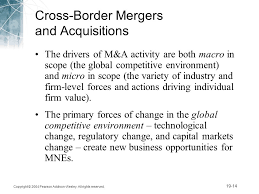
Explain the primary drivers behind cross-border acquisitions.

If you conduct an internet search using the terms “Facebook” and
“international,” you will find plenty of articles about Facebook’s
strategy for international growth. Explain why Facebook seeks to grow
internationally, its strategy for such growth, and the risks Facebook
faces with this strategy.

We can write this or a similar paper for you! Simply fill the order form!